
A Hand Up, Not a Hand Out: How Essex Meadows Resident Michael Dowley Is Transforming Children’s Lives in New Haven
July 21, 2026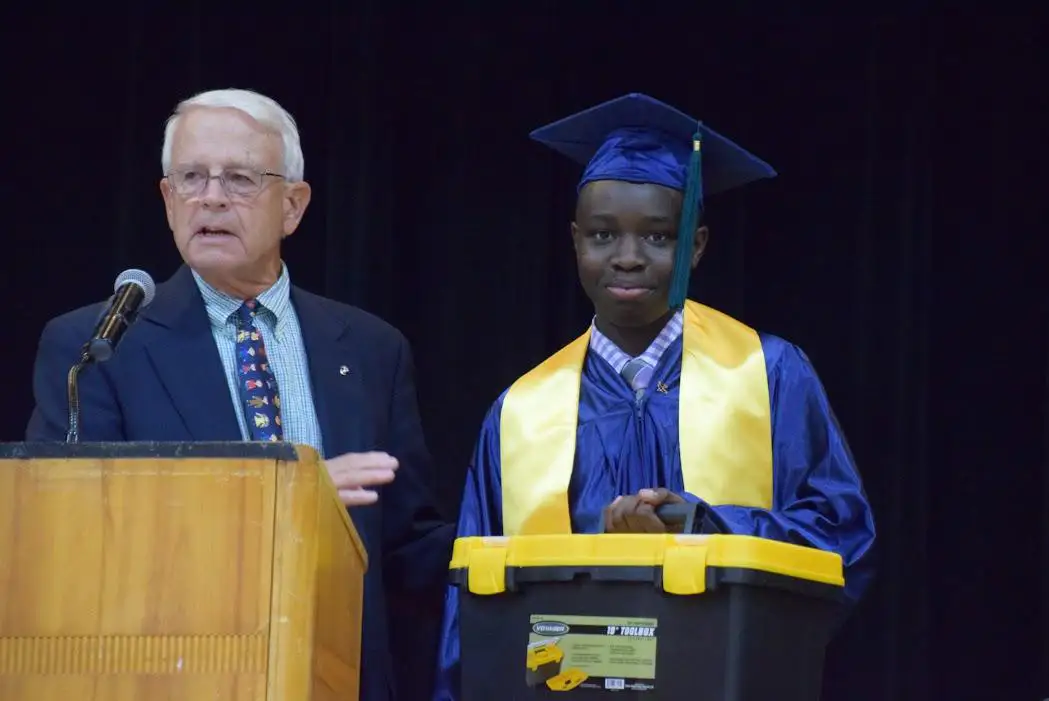
At 84 years old, Michael Dowley is still showing up for his community. Twenty years ago, he and a handful of like-minded people looked at what was happening to children from low-income families in New Haven – children falling years behind in school, losing ground they would never recover, disappearing eviction notices, shelter stays and fractured routines – and decided that someone needed to do something about it.
Essex Meadows resident and retired Ford Motor Company executive Michael Dowley spent his career not building things but building up people. He’s the kind of man who, when he decides someone needs to do something, tends to do it himself.
In 2005, Michael helped found the Saint Martin de Porres Academy, a tuition-free, faith-based middle school in New Haven serving children from low-income families. Through his and others’ generosity, Saint Martin Academy has become one of the quiet success stories of Connecticut education.
Its students arrive in fifth grade, often performing years below grade level. They leave in eighth grade headed to rigorous college-preparatory high schools on scholarship. The Academy proudly produces a 100% high school graduation rate and a 97% college acceptance rate. Its graduates are dramatically more likely to complete a four-year college degree than both their Connecticut peers and their economically disadvantaged counterparts nationwide. All of this is accomplished with almost zero public funding, sustained entirely by private philanthropy and the labor of more than 200 community volunteers.
Michael has been part of it from the beginning. At Essex Meadows, with the time and freedom that community life affords him, he intends to keep going.
A Career Built on Scale
Michael’s thirty-year career at Ford Motor Company carried him through Michigan, New York, Argentina, and Mexico, across fourteen moves and two continents, into roles of increasing scale and complexity. In Mexico, responsible for more than ten thousand employees, he navigated a moment when American and Canadian manufacturers flooded the market and effectively dismantled the workforce Ford had spent decades building south of the border. It was the kind of problem that required both strategic vision and human understanding – skills that would, in a different context, prove equally essential.
Near the end of his career, Ford named him Worldwide Director of Education and Training. He lasted a year, “until they found out I was having way too much fun,” as he tells it. But that year clarified something he’d observed throughout his career: that environment and structure don’t just influence outcomes, they determine them. That given the right conditions, people rise. And that the absence of those conditions is not a reflection of who someone is, but of what they’ve been denied.
“When I came back from Mexico,” Michael recalls, “I wanted to do something in education. I had no idea what that would be. So, I just started volunteering.”
Recognizing the Need
The Catholic parochial school system in New Haven had once been a pillar of the city’s working-class neighborhoods. Seven schools offered a structured, values-grounded education to children whose families might not otherwise have access to it. By the time Michael arrived as a volunteer, that system was unraveling.
Prosperous white families had long since moved to the suburbs, taking their financial support with them. Schools were closing, one by one.
“We found kids who were chronologically in the fifth grade, but whose math skills were at a first or second grade level,” Michael says. “They were already beginning to think of themselves as losers. Their chances of being successful seemed so remote.”
He and a number of close colleagues had been watching the closures, volunteering where they could, growing increasingly convinced that the need was outpacing institutions. They didn’t want to compete with the public school system, in which many children thrived, but they recognized a population that the public system simply couldn’t always reach. Too many children’s lives were too unstable, too disrupted, too governed by the daily emergencies of poverty to allow for the consistency that conventional schooling required.
“We didn’t know what we didn’t know,” Michael says. “We thought maybe we could do a little better. So we started.”
In 2005, Saint Martin de Porres Academy opened with a single class of fifth graders.
The school’s name was chosen with intention. Saint Martin de Porres was a 16th-century Peruvian friar of African and Hispanic heritage who spent his life ministering to the poor.
The Academy’s New Model of Education
Saint Martin de Porres Academy decided to take a different approach to education. Classes hold no more than twelve students, with at least two adults present at all times. The school day runs ten and a half hours; the year runs ten months. There is no tuition – ever, for anyone. The school makes a commitment to every student entering the Academy. “If you are willing to do the work, we will support you for twelve years, through middle school, high school and college or trade or professional school,” says Michael.
Certified teachers design curriculum and set the instructional framework, and retired educators and college graduates carry it forward in the classroom. Their costs kept manageable by a model that blends professional and volunteer labor with unusual effectiveness. More than 200 community volunteers – retired professionals, biotech researchers, downtown office workers – fill afternoons and evenings, helping students with homework and, just as critically, providing the kind of consistent adult attention that many children don’t have at home.
Every student learns a musical instrument. Sixth graders travel to a Vermont farm for a week of experiential learning. Students visit New York for theater and baseball. Yale University regularly opens its rehearsal spaces so small groups of Academy students can sit in on graduate vocal performances, with young opera singers in full costume, explaining their craft up close.
“Parents know that the worst thing in the world is a fifth-grade band concert,” Michael says with a laugh. “By eighth grade, they’re making music.”
The harder transformation is internal. Many of these children arrive convinced, at ten years old, that they are not capable of succeeding. Changing that belief is, in many ways, the Academy’s most essential work.
A School That Grows with Its Students
Michael and his co-founders assumed their job would be finished at eighth grade. They’re grateful to be wrong.
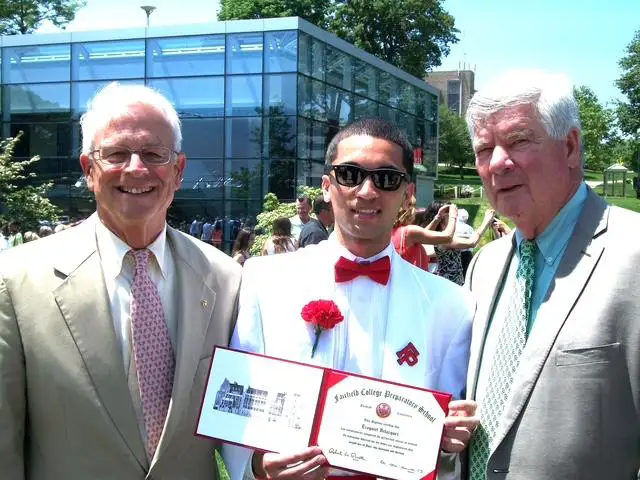
Their first graduating class earned places at competitive high schools like Notre Dame, Hopkins, and Fairfield Prep. The Academy quickly realized how much students benefitted from continued support beyond middle school. So, they built a high school program. Every afternoon, students who are graduates of the Academy and are now in high school, return to tutor and mentor the fifth through eighth grade students. Those high school students then have a safe and quiet space to do their homework with tutors available to help if needed.
“We’ve had people start tutoring a youngster in fifth grade and stay with them all the way through high school,” Michael says. “There’s more than just tutoring going on. They chat about different aspects of life. Many of our kids just have a mom at home, or they’re being raised by grandparents. Having that adult interaction is great for their growth, and great for their confidence.”
When students left for college, the Academy followed again. A Graduate Support Program tracks each student after graduation – helping them identify scholarships, navigate financial obstacles, and stay on course.
Two partner colleges now offer selected graduates full four-year scholarships. The Academy’s college-aged students are significantly more likely to complete a four-year degree than their peers, and dramatically more likely than their economically disadvantaged counterparts. And this past year, for the first time, a Saint Martin de Porres graduate was accepted to Yale.
The evidence of the model’s durability has come in quieter forms, too. Two of the Academy’s current classroom teachers are themselves graduates, returning to give back what was given to them. A third graduate now sits on the board of trustees, working as a principal engineer at a major firm. And at last spring’s eighth-grade graduation, the commencement speaker was a young man who had just completed his degree at Brown University.
“Every year, we have one of the college graduates come back and give that commencement address,” Michael says. “It just doesn’t get much better.”
A Life of Continued Purpose
Michael Dowley has been a resident of Essex Meadows for nearly five years. The move from the Guilford home he and his wife built and loved for two decades – the home they’d finally settled into after a career and Marine Corps service that spanned fourteen relocations – was not without its emotional weight. But what he found at Essex Meadows was something he hadn’t fully anticipated: the space, and the freedom, to keep being exactly who he is.
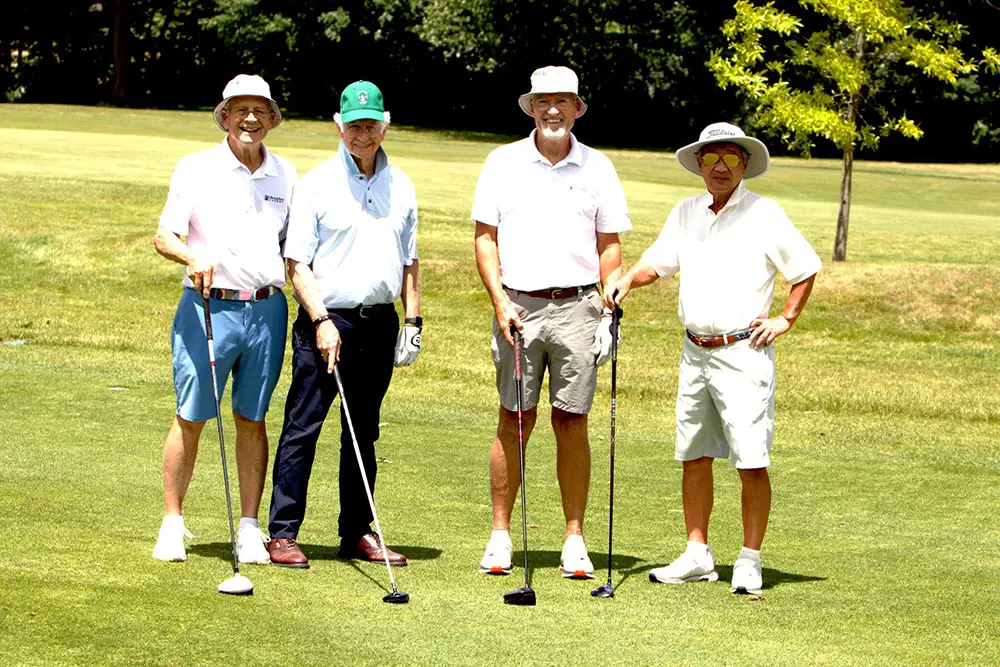
Essex Meadows sits close enough to Guilford and New Haven that Michael remains vice commander of his American Legion post, stays connected to his church and his doctors, and continues showing up for the Academy. Previously the building committee chair, he continues to serve on the board of trustees, currently overseeing a long-overdue renovation that will add an elevator to the school’s 1880 building. The board is currently chaired by a Yale University Project Engineer. Michael is also instrumental in the Academy’s annual golf tournament, working the room with the warmth of someone who understands that an institution like this runs on relationships as much as it runs on funds.
“Last week was our fundraising golf tournament,” he mentions almost in passing. “We raised about $110,000.”
The annual budget now exceeds two million dollars, raised without a single dollar of public money. There is always more to do.
“Doing this in retirement gives me a continuing sense of purpose,” he says. “I’ll be 85 in September. Having a purpose, being active, giving back, working with others who feel similarly about how important that is – it’s made this period of my life meaningful. I can’t imagine my life without it.”
“It’s a hand up, not a hand out. And it makes the world a better place for all of us.”
To learn more about Saint Martin de Porres Academy and how to support its mission, visit saintmartinacademy.org.